Free riddles for grown-ups, teens and kids
Math & Logic
48 free riddles at 4 levels. Filter by age or level, and reveal each answer when you are ready. No signup.
-
Three switches outside a windowless room each control one of three light bulbs inside. You can flip the switches as many times as you like, but you may only enter the room once. How do you determine, with total certainty, which switch controls which bulb?
Answer: Turn switch 1 on for several minutes, then turn it off. Turn switch 2 on and immediately enter the room. The lit bulb is switch 2's. The off-but-warm bulb is switch 1's. The off-and-cool bulb is switch 3's.
-
You have two identical eggs and a 100-floor building. You want to find the highest floor an egg can be dropped from without breaking, using as few worst-case drops as possible. What's the optimal worst-case number of drops?
Answer: 14 drops
Using a decreasing-interval strategy (start at floor 14, then 27, 39...), the worst case is bounded by the smallest n where n(n+1)/2 ≥ 100, which is n = 14.
-
A man must cross a river carrying a wolf, a goat, and a bag of cabbage, one at a time in a small boat. Left alone, the wolf eats the goat, and the goat eats the cabbage. How does he get everything across safely?
Answer: Take the goat across first and return alone. Take the wolf across, bring the goat back. Take the cabbage across and return alone. Finally, take the goat across.
The goat crosses twice, which is the key — it's never left alone with the wolf or the cabbage.
-
What comes next in this sequence, and why: 1, 11, 21, 1211, 111221, ?
Answer: 312211
Each term describes the previous one aloud ("look-and-say"): 111221 is "three 1s, two 2s, one 1," which becomes 312211.
-
You have 12 identical-looking coins, and exactly one is counterfeit — either heavier or lighter than the rest, but you don't know which. Using a balance scale, what's the minimum number of weighings needed to both identify the counterfeit coin and determine whether it's heavier or lighter?
Answer: 3 weighings
-
Four people need to cross a rickety bridge at night, sharing one flashlight that must be carried on every crossing. The bridge holds only two people at a time, and a pair moves at the slower person's pace. Crossing times are 1, 2, 5, and 10 minutes. What is the minimum total time for everyone to cross?
Answer: 17 minutes
Send the two fastest (1+2) across together, send the fastest back, send the two slowest (5+10) across together, send the second-fastest back, then send the two fastest across again: 2+1+10+2+2 = 17.
-
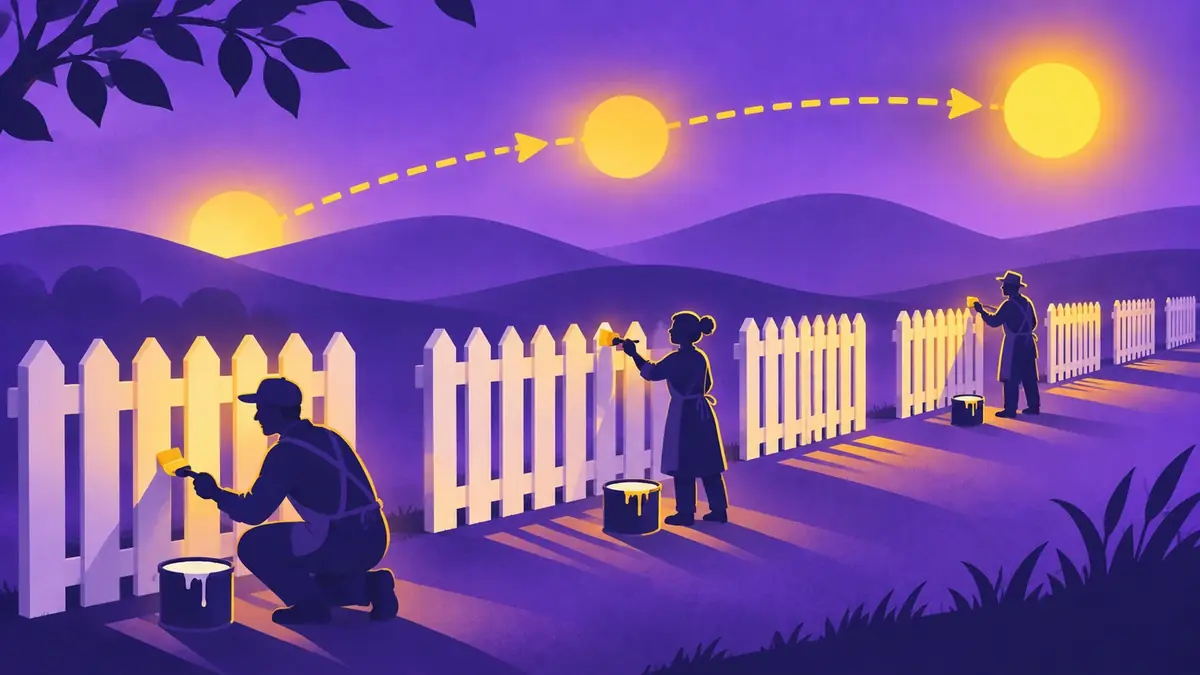
If it takes 5 people 5 hours to paint 5 identical fences, how long does it take 10 people to paint 10 identical fences, at the same steady rate?
Answer: 5 hours
The ratio of people to fences stays 1:1, so each person still needs the same 5 hours to finish their own fence.
-
A father is currently 4 times as old as his son. In 20 years, he'll be exactly twice as old as his son. How old are they now?
Answer: The father is 40 and the son is 10.
f = 4s and f + 20 = 2(s + 20) → 4s + 20 = 2s + 40 → s = 10, f = 40. Check: in 20 years, 60 = 2 × 30.
-
You reach a fork in the road: one path leads to the city, the other to certain ruin. Two guards stand there — one always tells the truth, one always lies, and you cannot tell which is which. You may ask exactly one yes-or-no question, to exactly one guard. What do you ask?
Answer: Ask either guard: "If I asked the other guard whether the left path leads to the city, would he say yes?" Then take the opposite of the answer you get.
Either the truth-teller faithfully reports the liar's lie, or the liar misreports the truth-teller's honest answer — either way the reply is inverted exactly once, so it is reliably wrong. Reliably wrong is as useful as reliably right.
-
Twenty-three people are picked at random and put in one room. Roughly what is the probability that at least two of them share a birthday?
Answer: About 50% — 50.7%, to be exact
What matters is not "you against everyone else" but the 253 possible pairs among 23 people. Multiplying 365/365 × 364/365 × … × 343/365 gives about a 49.3% chance of no shared birthday at all.
-
A drawer in a pitch-black room holds 10 black socks and 10 blue socks, identical except in colour. How many socks must you take out to be certain of a matching pair — and how many to be certain of a black pair?
Answer: Three for a matching pair; twelve for a black pair.
Three socks can only be two colours, so two of them must match. But the worst case for black is drawing all 10 blue socks first, then 2 black ones — 12 in total.
-
Imagine a rope tied snugly around the Earth's equator. You add exactly one metre to its length, then lift it so it stands the same height above the ground the whole way round. Roughly how high off the ground is it?
Answer: About 16 centimetres — enough to slide your hand under.
Circumference is 2πr, so adding 1 m of rope raises the radius by 1 ÷ 2π ≈ 0.159 m. The size of the Earth cancels out completely — the answer is identical for a rope around a tennis ball.
-
A pile of 21 stones sits between two players. They take turns removing 1, 2, or 3 stones, and whoever takes the last stone wins. Would you rather move first or second, and what is the strategy?
Answer: Move first: take 1 stone, then always take 4 minus whatever your opponent just took.
Taking 1 leaves 20, a multiple of 4. From then on each full round removes exactly 4 stones, so your opponent always faces a multiple of 4 and you take the last stone. Any pile that is a multiple of 4 loses for whoever has to move.
-
A disease affects 1 person in 10,000. A screening test catches 99% of the people who have it, and wrongly flags 1% of the people who don't. You test positive, with no symptoms and no risk factors. Roughly what is the chance you actually have it?
Answer: About 1%
Picture 10,000 people: about 1 has the disease and tests positive, while about 100 healthy people also test positive. That is roughly 1 true positive per 101 positives. Ignoring how rare the disease is — the "base rate" — is the classic error here.
-
Two trains start 300 miles apart and travel toward each other — one at 60 mph, the other at 40 mph. How long until they meet?
Answer: 3 hours
Their combined closing speed is 100 mph, and 300 ÷ 100 = 3.
-
The sum of three consecutive whole numbers is 72. What are the three numbers?
Answer: 23, 24, and 25
n + (n+1) + (n+2) = 72 → 3n + 3 = 72 → n = 23.
-
A rectangular garden is twice as long as it is wide. Its perimeter is 60 meters. What are its dimensions?
Answer: 10 meters wide by 20 meters long
l + w = 30 and l = 2w, so 3w = 30, giving w = 10 and l = 20.
-
If 5 machines can make 5 widgets in 5 minutes, how long would it take 100 machines to make 100 widgets?
Answer: 5 minutes
Each machine makes 1 widget every 5 minutes — adding more machines making more widgets in parallel doesn't change that per-machine time.
-
You have an unmarked 3-liter jug and an unmarked 5-liter jug. How can you measure out exactly 4 liters of water?
Answer: Fill the 5L jug, pour into the 3L jug until it's full (2L stays in the 5L jug). Empty the 3L jug, then pour that 2L into it. Fill the 5L jug again, then top off the 3L jug (which needs 1 more liter) from it — that leaves exactly 4L in the 5L jug.
-
What is the smallest 4-digit palindrome (reads the same forwards and backwards) that is also an even number?
Answer: 2002
The last digit has to match the first and be even; 1 is odd, so the smallest working first/last digit is 2, giving 2002.
-
What is the next number in this sequence: 2, 6, 12, 20, 30, ?
Answer: 42
The differences between terms increase by 2 each time (4, 6, 8, 10, 12); each term is n×(n+1).
-
If you flip a fair coin 3 times, what is the probability of getting at least one heads?
Answer: 7/8
1 − (probability of all tails) = 1 − (1/2)³ = 1 − 1/8 = 7/8.
-
A jacket is marked down 20% in a sale. At the register, a coupon takes a further 20% off the sale price. What is the total discount off the original price?
Answer: 36%
The second cut applies to the already-reduced price: 0.8 × 0.8 = 0.64, so you pay 64% of the original — a 36% discount, not the 40% the two numbers suggest.
-
A jar holds red and blue marbles in a ratio of 3 to 5. There are 24 more blue marbles than red ones. How many marbles are in the jar altogether?
Answer: 96
Write the counts as 3k and 5k. The difference 2k = 24, so k = 12 — that is 36 red and 60 blue, 96 in all.
-
You drive 60 km to the next town at a steady 60 km/h, then drive the same 60 km home at a steady 30 km/h. What is your average speed for the round trip?
Answer: 40 km/h
The trip out takes 1 hour and the trip back takes 2 — 120 km in 3 hours. Averaging the two speeds (45) is the trap: you spend twice as long travelling at the slower one.
-
One tap fills a bathtub in 6 minutes. A second tap fills the same tub in 3 minutes. With both running together, how long does the tub take to fill?
Answer: 2 minutes
Add the rates, not the times: 1/6 + 1/3 = 1/2 of a tub per minute, so one full tub takes 2 minutes.
-
In a class of 30 students, 18 play football and 15 play basketball. 5 students play neither sport. How many students play both?
Answer: 8
30 − 5 = 25 students play at least one sport. 18 + 15 = 33 counts every both-player twice, so 33 − 25 = 8 play both.
-
Ten people meet at a party, and every person shakes hands with every other person exactly once. How many handshakes take place?
Answer: 45
Each of the 10 people shakes 9 other hands, giving 90 — but that counts every handshake once from each side, so the real total is 90 ÷ 2 = 45.
-
It's 3:15 on a clock. What is the angle between the hour hand and the minute hand, in degrees?
Answer: 7.5 degrees
The minute hand sits at 90°; the hour hand has moved a quarter of the way from 3 to 4, landing at 97.5°.
-
I am a three-digit number. My tens digit is five more than my ones digit, and my hundreds digit is eight less than my tens digit. What number am I?
Answer: 194
Ones = 4, tens = 4 + 5 = 9, hundreds = 9 − 8 = 1.
-
Using only the digit 8 and the plus sign, how can you add together eight 8s to make exactly 1,000?
Answer: 888 + 88 + 8 + 8 + 8 = 1,000
-
Pick any number. Double it, add 10, divide the result by 2, then subtract your original number. No matter what number you start with, you'll always end up with the same answer. What is it?
Answer: 5
The math always simplifies to 5, no matter which number you start with.
-
Can you find three positive whole numbers where adding them together gives you the exact same result as multiplying them together?
Answer: 1, 2, and 3
1 + 2 + 3 = 6, and 1 × 2 × 3 = 6.
-
A bat and a ball together cost $1.10. The bat costs exactly $1.00 more than the ball. How much does the ball cost?
Answer: 5 cents
If the ball costs x, the bat costs x + $1.00, so 2x + $1.00 = $1.10, meaning x = $0.05.
-
In a class, exactly half the students are girls. If 3 more girls join the class, girls would make up 60% of the class. How many students were originally in the class?
Answer: 12
Start with 12 students (6 girls). Adding 3 girls makes 9 girls out of 15 students — 60%.
-
Pick any number. Double it, add 6, divide the result by 2, then subtract your original number. What do you always end up with?
Answer: 3
The math always simplifies to 3, no matter which number you start with.
-
A snail is at the bottom of a 10-meter well. Each day it climbs up 3 meters, but each night it slides back down 2 meters. How many days does it take the snail to reach the top?
Answer: 8 days
The snail nets 1 meter a day for 7 days (reaching 7m), then climbs the final 3m on day 8 and gets out before it can slide back.
-
You have 8 identical-looking coins. One is a fake that's slightly heavier than the rest. Using a balance scale, what's the fewest number of weighings you need to guarantee finding the fake?
Answer: 2 weighings
Split the coins 3-3-2. Weigh the two groups of 3 first, then narrow down with one more weighing.
-
There are 3 apples in a bowl on the table. You take 2 of them and put them in your bag. How many apples do you have?
Answer: 2 — the two in your bag
Almost everyone answers 1, because 1 is what's left in the bowl. But nobody asked about the bowl: you took 2, so you have 2.
-
Every coin in my pocket is either silver, gold, or copper. All of them are silver except two. All of them are gold except two. All of them are copper except two. How many coins are in my pocket?
Answer: 3
One silver coin, one gold coin, one copper coin. Only one of them is silver — so all of them are silver "except two," and the same story is true for the gold one and the copper one.
-
Nour is waiting in the line for the water fountain. She is 3rd from the front of the line, and she is also 3rd from the back. How many children are in the line?
Answer: 5
Two children in front of her, two behind her, and Nour herself: 2 + 2 + 1 = 5. The tempting answer is 3 + 3 = 6 — but that counts Nour twice, once from each end.
-
Six birds are sitting on a branch. Two of them decide to fly away to another tree. How many birds are still on the branch?
Answer: All six
Deciding to fly away isn't the same as flying away. Until those two actually push off the branch, all six birds are still sitting right there.
-
Tom is 8 years old, and his little sister is half his age. How old will his sister be when Tom is 16?
Answer: 12
His sister is 4 today, which makes her exactly 4 years younger than Tom — and she will be 4 years younger than him forever. So when Tom is 16 she is 12, not 8. She is "half his age" only today.
-
The big clock in the town square bongs once for every hour — 4 bongs at 4 o'clock, 7 bongs at 7 o'clock. It takes the clock 6 seconds to bong 4 o'clock. How long does it take to bong 7 o'clock?
Answer: 12 seconds
The seconds are in the gaps between the bongs, not in the bongs. Four bongs have only three gaps between them, so each gap is 6 ÷ 3 = 2 seconds. Seven bongs have six gaps: 6 × 2 = 12 seconds. (The tempting answer is 10 and a half — but that would mean a gap after the last bong, and there isn't one.)
-
A farmer's field has only ducks and cows in it. The farmer counts 5 heads and 14 legs. How many ducks and how many cows are in the field?
Answer: 3 ducks and 2 cows
Five heads means five animals. Draw five animals and give each one 2 legs — that is only 10, so 4 legs are still spare. Each cow needs 2 legs more than a duck, so the spare 4 legs make 2 cows, and the other 3 are ducks. Check it: (3 × 2) + (2 × 4) = 14.
-
You have $5 and your little brother has $1. You are feeling generous, so you give him $2. Now who has more money — you or your brother?
Answer: Neither — you each have exactly $3
Handing over $2 doesn't only make him $2 richer, it makes you $2 poorer at the same moment — so the $4 gap between you closes twice as fast as you'd think. $5 − $2 = $3, and $1 + $2 = $3.
-
A rooster lays an egg right on the very top of a barn roof. Which way does it roll — left or right?
Answer: Neither — roosters don't lay eggs
Only hens lay eggs, so there is no egg to roll in the first place.
-
There are 12 fish in a tank. Half of them swim behind a big rock where nobody can see them. How many fish are in the tank now?
Answer: 12 — all of them
Six of them are hidden, but hiding behind a rock does not take a fish out of the tank. Read the question again: it asks how many are IN the tank, not how many you can see.













No riddles here yet — try a different type, or switch to "All riddles" / "Solved" above.
Want a paper copy? Open the printable Math & Logic riddle sheet